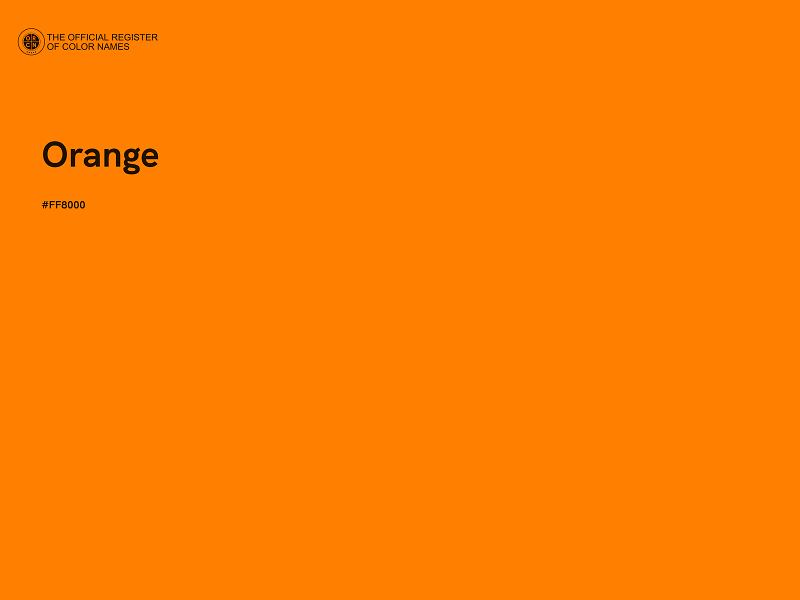
Information about Orange color

#FF8000 - Orange color image

The history behind the Color Name Orange

The origin of the color name "orange" can be traced back to the fruit of the same name. The fruit was named after the tree it grew on, which was called the "orange tree." The Sanskrit word for the orange tree was "naranga," which eventually evolved into "naranj" in Persian and "naranca" in Spanish. The Spanish word for the fruit eventually became "orange" in English, and the color was named after the fruit.

It is believed that the orange fruit was first cultivated in China and then brought to Europe through trade routes. The color orange was not widely used as a color name in English until the 16th century, and it was not commonly used as a color term in art until the 18th century. The color was created by mixing red and yellow pigments, and it became increasingly popular as an artistic color in the 19th and 20th centuries.

Basic facts about this digital color

The digital color #FF8000, known as "Orange", is classified in the Register under the Orange Color Family, with Full Saturation and Light brightness. In numbers: rgb(255, 128, 0) (100% red, 50.2% green, 0% blue), or CMYK 0 / 50 / 100 / 0 for print. New to color codes? See our guide to RGB color codes.

#FF8000 is a intensely saturated warm orange that sits on the lighter side of the spectrum. In practice it works well for bold branding moments and attention-grabbing details. In The Official Register of Color Names it is almost identical to Fanta Orange (#FF8300). Nearby in the Register you will also find Heat Wave (#FF7A00) and Flamenco (#FF7D07).

The recipe behind #FF8000 is rgb(255, 128, 0), with red as the dominant ingredient. If you plan to put text on a #FF8000 background, choose black — the contrast ratio is 8.3:1 (passing WCAG AAA), while white manages only 2.5:1. The name "Orange" is officially recorded for this exact shade in The Official Register of Color Names.

Orange color variations

View this color variations of tints, shades, tones and hues.

Orange color harmonies

Color harmonies are pleasing color schemes created according to their position on a color wheel.

Complementary

Complementary color schemes are made by picking two opposite colors con the color wheel. They appear vibrant near to each other.
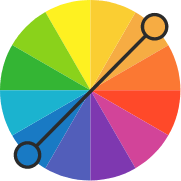
Complementary color schemes

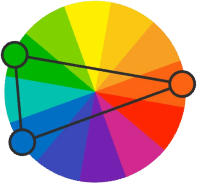
Split complementary

Split complementary schemes are like complementary but they uses two adiacent colors of the complement. They are more flexible than complementary ones.

Split complementary color scheme

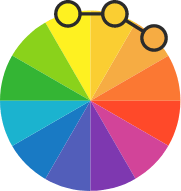
Analogous

Analogous color schemes are made by picking three colors that are next to each other on the color wheel. They are perceived as calm and serene.

Analogous color scheme

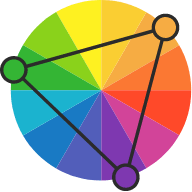
Triadic

Triadic color schemes are created by picking three colors equally spaced on the color wheel. They appear quite contrasted and multicolored.

Triadic color scheme

Tetradic

Tetradic color schemes are made form two couples of complementary colors in a rectangular shape on the color wheel.
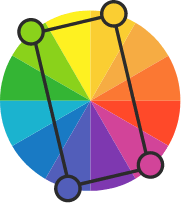
Tetradic color scheme

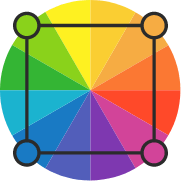
Square

Square color schemes are like tetradic arranged in a square instead of rectangle. Colors appear even more contrasting.

Square color scheme

Nearest named colors to Orange

The closest officially registered color names in the Register, ordered by similarity.

Orange color backgrounds & wallpapers

Download color wallpaper / background for your Desktop PC, Tablet or Mobile phone.

Conversions between color systems and etc.

  • HEX#FF8000
  • RGB255, 128, 0
  • CMYK0, 50, 100, 0
  • HSL30°, 100%, 50%
  • HSL Precise30.118°, 100%, 50%
  • HSV30°, 100%, 100%
  • HSB30°, 100%, 100%
  • HEX IDFF8000
  • DECIMAL ID16744448
  • Name Length6
  • Color Family (Hue)Orange
  • Saturation FamilyFull Saturation
  • Lightness FamilyLight
  • Percentage of Red in RGB100%
  • Percentage of Green in RGB50.2%
  • Percentage of Blue in RGB0%
  • This page visited921 times
  • Counting from2025-01-01